Uncategorised
ASC Club Pistol
This monthly match is open to members and invited guests and is great for both beginners and experienced shooters. Juniors are especially welcome.
The match is fired from 25 yards. We hang six targets, with one marked as practice for sighters. Unlimited sighters are allowed, shot whenever you like them (before, after, between targets for score). 5 shots for score are fired at each of the other five targets with no time limit.
Shoot the match with a rimfire handgun, and again with a centerfire if you like. $5 per match, ($10 per day range fee for invited guests.) The funds collected will be split between the club and a small prize pool. No fees or prize pool for juniors.
The Match takes place as shown on the schedule below - Third Sunday of each month, April through October - Sign in from 11:30am to 2:30 PM. Shooting begins at noon or once setup is completed.
The Match will be held on the East Side Bullseye range.
2026 Dates:
- April 19th
- May 17th
- June 21st
- July 19th
- August 16th
- September 20th
- October 18th
Registration is not required. Please have cash on the day of the event.
Course of Fire:
Firearm: Any pistol
- Any rimfire handgun or any caliber centerfire handgun, single shot, revolver or semi-auto
Sights: Any sights
- Metallic, any (open, peep, etc.)
- Electronic, any (dot, laser, etc.)
- Telescopic, any type
Distance: 25 yards
Target: ASC "Club" target - scores X through 5; 1" 'X', 2" 10 ring, 4" 9 ring, etc.
Stance: Free standing (Cannot lean against bench, posts, etc.). One handed or two-handed grip permitted.
Course of Fire: 5 Targets, 5 shots in each target with no time limit. Unlimited sighters (at any time) on pre-marked sighter club target. You are allowed any number of shots per target, until you get 5 hits in the scoring rings. Excessive scoring hits result in the low 5 scoring hits being counted.
Scoring: Point scoring
- High score - high X: 250-25X maximum.
Match Director: Bob McLear
Questions? Contact Bob McLear (This email address is being protected from spambots. You need JavaScript enabled to view it.)
Across The Course Matches
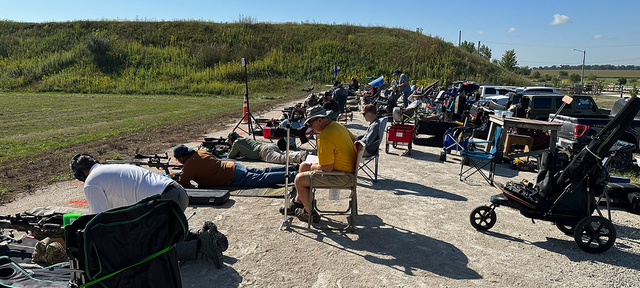
F-Class is a shooting sport that originated in 1995. It was intended for those familiar with or interested in Long-Range shooting. It is easy to get into and learn and a lot of fun!
The matches are shot in a manner referred to as "slow fire" (as opposed to "rapid fire"). Only one round in the gun at a time. Got a 30-round magazine? Fine, but you can only load one round at a time. Because you shoot next to a competitor from a prone position, muzzle breaks are not allowed, and the caliber must be under 35 cal. The 6mm, 6.5 mm, 284 (7mm), and several 30 cals are commonly found on the line in Mid-Range F-Class Open matches. For F-TR, the .223 Rem and 308 Win are your go-to.
At ASC, we usually shoot three "strings" of 20 shots. They might all be at one distance (say, 600yds), or you may have to change yard lines between each string (300, 500, 600yds). At 600 yards, your goal is to hit the 3" diameter X-ring as often as possible. ASC uses Silver Mountian Electronic Target, which will display your score and the location of your hit on your phone, tablet, or laptop within 7 seconds of your shot. You adjust your aim and shoot again. If you hit the "9" ring, you get a score of 9; if you hit the 10 ring or the X ring, you get a score of 10, 8 points for 8 ring, and so on. After 20 shots for record, your score is totaled, and that is your final score for that "relay." Each match consists of 3 relays for 60 shots (+sighter shots) per match. Expect to shoot 70 to 75 rounds of ammo at a match.
F-Class targets are fairly challenging. The X-ring is 1/2 minute across, and the 10-Ring is 1 minute across. It's just a little over a 1/4 minute from the edge of the X ring to the 9 ring, not a lot of room for error.
If you plan to compete in Mid-Range F-Class, below is a list of equipment you should bring:
- Rifle chambered in .223-35 cal (only one round in the gun at a time). Any power scope is permitted, so long as the rifle does not exceed the weight limit.
- Front rest, bipod, or sandbag
- Rear bag ("rabbit-ear" style bag is acceptable)
- Shooting mat
- At least 70 rounds of ammunition. Hand-loaded or Match-grade ammunition.
- Spotting scope and stand optional.
To learn more about F-Class competition visit: https://www.ssusa.org/articles/2016/12/15/getting-started-in-f-class-competition/
Safety Briefing: F-Class Safety Briefing
Smallbore F-Class
Smallbore F-Class is a slow fire prone discipline. Competition is limited to 22LR rifles. Matches are fired at known distances of 50 yards, 50 meters, and/or 100 yards. Matches are single-load, and while not required, most shooters use bolt-action target rifles. A typical match is two strings of 20 rounds in 20 minutes each at 50 yards, followed by two strings of 20 rounds in 20 minutes at 100 yards.
This is a precision shooting discipline, and the targets are small. At 50 yards, the X ring is about the diameter of a .22 caliber bullet and the 10 ring is about the diameter of a dime. The entire bullseye target is a little over 5.5 inches in diameter. At 100 yards, the 10 ring is 1” in diameter. Any shot which passes through the 10 ring without breaking the outer edge of the ring is scored as an X. The entire bullseye target is a little under 12 inches in diameter.
Shooters are divided into two basic categories: F-TR (Target Rifle) and F-Open. The main difference between these categories in Smallbore F-Class is that F-Open shooters may use a front pedestal-type rest, where F-TR shooters must use either a bipod or sandbags. For either category, a rear support is allowed under the rifle butt, such as a “rabbit ear” bag, a gloved hand, or a sandbag. For both categories, the rifle is restricted to a weight of 18.18 lbs, including anything affixed to the rifle (scope, bipod, etc.). Both are unrestricted as to the power of scopes that may be used, so long as the rifle is within the weight limit.
If you plan to compete in Smallbore F-Class, below is a list of equipment you should bring:
- Rifle chambered in 22LR – bolt action or semiautomatic. No rifles with tube-fed magazines are permitted. Any power scope is permitted, so long as rifle does not exceed weight limit.
- Front rest, bipod, or sandbag
- Rear bag (“rabbit-ear” style bag is acceptable)
- Shooting mat
- At least 100 rounds of ammunition. Match-grad subsonic ammunition is strongly recommended, but not required.
- Spotting scope and stand recommended, but not required.
- Sun screen, insect repellant, and drinking water are highly recommended.
Questions? Please contact Greg Coyle at: This email address is being protected from spambots. You need JavaScript enabled to view it.